
Know Your Foes: Six Winter Wildlife Pests

Winter proofing residential, commercial or industrial buildings to withstand the onslaught of Midwestern winter is about more than snow removal and insulation. In fact, diligence when it comes to keeping warm air circulating can make buildings an attractive option for wildlife squatters looking for a winter refuge.
Here is an overview of six varieties of wildlife that may make themselves at home if they can find a gap in your winter-proofing strategies.
Raccoons

The largest of the common nuisance animals, raccoons can be 15 to 30 inches in length and weigh as much as 40 pounds in some areas, though 10 to 20 pounds is typical.
Raccoons love the spaces humans leave unattended in their buildings and are equally at home in crawl spaces or attics. Raccoons, however, make terrible guests as they forage for food, knocking over potted plants, trashcans, and anything else that isn’t nailed down! Raccoons are mostly nocturnal, most often seen at night or shortly before sunrise and shortly after sunset.
Raccoons are strong and creative invaders. They will often find an area where parts of the building are not quite fully sealed or that has a builder’s gap, like a soffit return or the edge of the decking board on the roof. They will chew and tear their way in, leaving buildings exposed to the elements. Once inside, raccoons tear into insulation and air ducts, establish a communal latrine and create a mess that requires significant remediation and sanitization.
Squirrels

Piney squirrels are inconsiderate guests and despite their small size — 15-20” from head to tail and weighing only half a pound — these white-bellied red and white creatures with white-ringed eyes create big problems in the spaces they colonize. They’re noisy and destructive, chewing wires and other materials and rolling their stash of walnuts around.
Fox squirrels are the largest breed of tree squirrel in North America, 18-24 inches long including tails, and weighing from one to three pounds. They are distinguished by their rust brown colored back and orange belly and underside of tail.
While fox squirrels prefer to nest in trees, they will occasionally chew their way into a building to nest inside, usually close to the entry point. They are less likely than a piney squirrel to run throughout the entire structure, but they can create unsettling noises and damage that leaves a building exposed to the elements.
Opossums
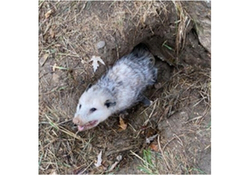
North America’s only marsupial, opossums are typically 18 to 30 inches long with an 8-to-14-inch prehensile tail that they can wrap around things. Most are white and grey with black portions around their legs, eyes, ears, and mouth.
Possums are opportunists and will eat whatever is easiest to find, including carrion, garbage, or unattended pet food. They are nocturnal, solitary and nomadic and rarely force their way into anything or climb more than a couple of feet at a time. They are most often found under porches or crawl spaces and typically only stay a few days.
Chipmunks

Small, with a 6-to-8-inch body and a 4-inch tail, these busy little rodents have reddish, brown fur on their sides and contrasting light and dark stripes on their backs.
Chipmunks occasionally get into building crawl spaces or external walls. Their tunnel systems can leave property and flowerbeds damaged.
They often have multiple areas of refuge on one property including brush piles, holes between a porch and house slab or rocks around a garage.
English Sparrows and European Starlings


English sparrows are small, (4 to 6 inches) predominantly brown and white birds with different markings for males and females. Starlings are larger, about 6 to 8 inches, with predominantly black feathers with white and iridescent green flecks. Males and females look the same, but their beaks are black in the winter and yellow in the summer.
Both species are cavity nesters and will make a large nest in attics, soffit, or exhaust vents for dryers and furnaces. Both are active at all times of the day, calling to other birds, entering and exiting the structure, and scavenging food.
Their nests can create both airflow obstructions and a fire hazard, as their nesting material is often hay or straw. The interference with exhaust flow can also cause heaters to become overworked and inefficient and their waste can harbor disease-causing microbes.
Help with Winter Wildlife Pests
Don’t wait until winter wildlife problems escalate. Professional wildlife removal and exclusion services can prevent expensive problems. At Rusty’s Animal Control, we have decades of expertise in both removal and prevention tools, including effective exclusion devices for raccoons, squirrels, bats, rodents and pest birds.
Our services are cost-effective, humane and thorough, with a strong focus on prevention.